
























How Satellite Battery Power Is Becoming the Backbone of the Commercial Space Economy
How Satellite Battery Power Is Becoming the Backbone of the Commercial Space Economy
In the global discussion around commercial satellites, attention usually centers on launch vehicles, reusable rockets, or mega-constellations. Yet behind every satellite orbiting Earth lies a far more fundamental question:
How does it stay alive?
The answer is simple—but the implications are massive: satellite battery power.
A Turning Point for Commercial Space
By 2025, China’s commercial space sector reached a critical milestone. That year alone, over 300 commercial satellites were successfully launched, accounting for more than 80% of all satellites placed into orbit. By year-end, the number of operational commercial satellites exceeded 800 .
But this is only the beginning.
China has already filed spectrum and orbital resource applications with the International Telecommunication Union (ITU) for more than 200,000 low Earth orbit (LEO) satellites. When combined with U.S. and European mega-constellations, the global satellite population is heading toward an unprecedented expansion.
This exponential growth brings satellite battery power into the spotlight
as a strategic bottleneck.
Every Satellite Has a Heart
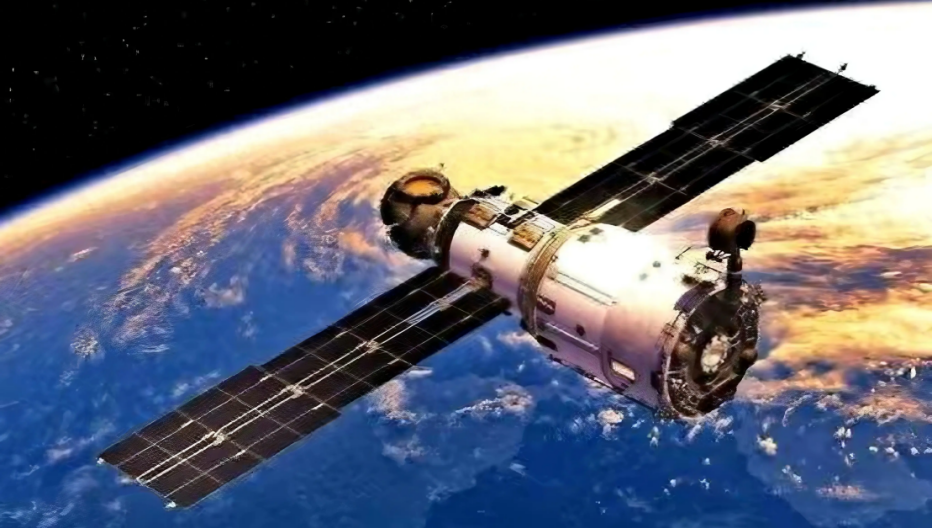
Whenever a satellite enters Earth’s shadow—sometimes every 90 minutes in LEO—solar panels stop generating electricity. At that moment, the onboard battery becomes the satellite’s only lifeline.
Unlike terrestrial batteries, satellite battery systems must:
● Operate across extreme temperature swings (from deep cold to intense solar heating)
● Withstand high-energy radiation in vacuum
● Deliver reliable power for 5–8 years without maintenance
● Complete ~30,000 charge–discharge cycles
● Fail never, because replacement is impossible
A single battery failure means the total loss of the satellite, often translating into hundreds of millions of dollars in sunk cost.
This is why satellite battery power is considered one of the highest technical barriers in the aerospace value chain .
A Market Quietly Approaching Trillion-Dollar Scale
In 2024, China’s commercial space market surpassed USD 320 billion (≈ RMB 2.3 trillion). Projections suggest it could approach USD 1.1 trillion by 2030, growing at over 23% CAGR .
Satellite batteries may not be the most visible component—but they are non-substitutable.
Conservative Market Economics
Typical assumptions for a commercial satellite:
● Battery capacity: ~ 5 kWh
● Cost per Wh: ~ USD 14–15 / Wh (≈ RMB 100 / Wh)
● Battery value per satellite: USD 70,000–280,000
If only 100,000 satellites are deployed over the next decade, the battery market alone exceeds USD 14 billion. With technology upgrades, redundancy, and replacement strategies considered, total market potential may reach USD 70+ billion.
For the 200,000-satellite LEO filings, lithium-based satellite battery power demand alone is estimated at USD 26–53 billion .
Why LEO Satellites Drive Battery Innovation
Three structural forces are accelerating demand:
1. Explosive Growth of LEO Constellations
LEO satellites experience rapid orbital cycles and frequent eclipses, placing extreme stress on battery cycle life, far beyond GEO requirements.
2. Rising Payload Power
Modern satellites now carry high-throughput communications, radar, and advanced sensing payloads, pushing power demand from kilowatts to tens of kilowatts—raising the bar for energy density and discharge capability.
3. Commercial Cost Pressure
As satellite unit costs fall toward the million-dollar level, batteries must achieve a new balance between ultra-reliability and cost efficiency—a challenge similar to, yet more extreme than, EV battery evolution.
Why Space Is Not Earth
Simply adapting ground-based batteries for orbit is a recipe for failure.
For comparison:
Application | Temperature Range | Cycle Life |
UAV batteries | -20°C to +60°C | 500–1,000 cycles |
Satellite batteries | Extreme orbital swings | ~30,000 cycles |
This difference forces entirely different material systems, packaging
designs, and safety architectures .
Solid-State Batteries: A Natural Fit for Space
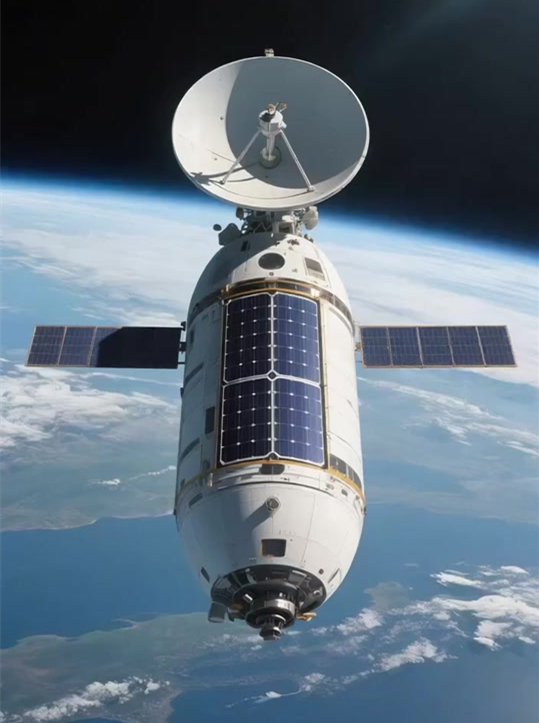
Traditional liquid lithium-ion technology is nearing its physical limits in space. Solid-state batteries are emerging as a game-changing solution for satellite battery power.
Key Advantages
● Wider operating temperature window
● No liquid electrolyte → no gas generation in vacuum
● Higher chemical and radiation stability
● Significantly higher theoretical energy density
NASA's SABERS program has demonstrated 500–550 Wh/kg, with over one year of in-orbit testing and only ~5% capacity degradation. NASA, JAXA, and ESA all identify 2028 as a critical milestone for large-scale solid-state adoption .
The 2025–2028 window is widely seen as a technology reset phase for satellite battery power.
From State-Led to Commercial Breakthroughs
Historically, satellite power systems in China were dominated by state-owned aerospace institutes with decades of accumulated expertise and strict qualification systems.
Commercial space has started to change that.
Private companies are now entering through:
● Small LEO satellite platforms
● Key materials and components
● Battery management systems (BMS) and power electronics
Industry value distribution roughly follows:
● Upstream materials & core components: 40%
● System integration: 35%
● Downstream operations & services: 25%
This structure creates clear entry points for specialized technology
providers.
Policy, Capital, and Momentum
In late 2025, China formally integrated commercial space into its national aerospace strategy, reinforcing regulatory clarity and long-term commitment. Capital markets followed, lowering entry barriers for private companies.
Large LEO programs alone now represent multi-billion-dollar battery demand, amplified further by reusable launch vehicles that reduce deployment cost and accelerate constellation build-out .
From Low Altitude to Orbit: A Realistic Path
For companies with experience in UAVs, robotics, or EV battery systems, entering satellite battery power is not a simple transfer—but a system-level upgrade.
Viable strategies include:
1. Starting with standardized battery modules for small satellites
2. Investing early in solid-state battery platforms
3. Specializing in aerospace-grade BMS and power management systems
The barriers are high—long R&D cycles, expensive certification, and delayed returns. But once trust is established, customer lock-in and technical moats are exceptionally strong.
The Window Is Open
Two hundred thousand satellites.
Tens of billions of dollars in battery demand.
Clear policy signals.
A defined technology inflection point.
Commercial space is accelerating—and satellite battery power is no longer a
background component, but a defining capability.
Every satellite needs an energy heart capable of beating reliably in the harshest environment known to engineering.
The only remaining question is:
Will you watch this transformation—or help power it?
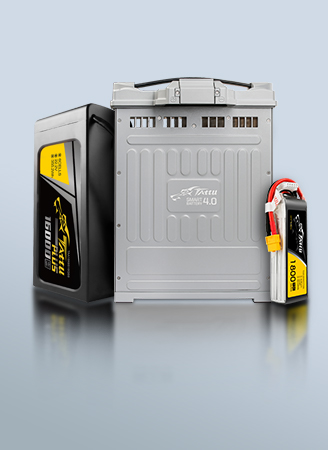
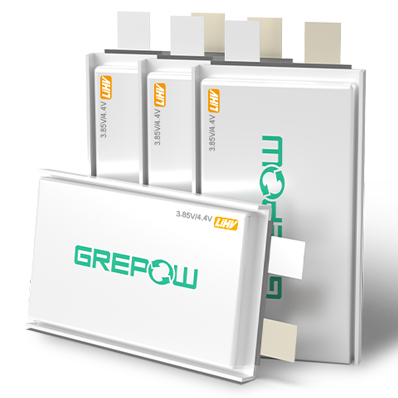
In drones, RC models, and other high-reliability power applications, batteries are no longer just power components—they are the foundation of system stability. Leveraging years of cell R&D and system integration expertise, Grepow has developed stable power solutions designed for wide operating temperature ranges (from -40°C to high-temperature environments). These battery solutions deliver consistent and reliable performance in cold starts, high-load discharge, and long-duration operation.
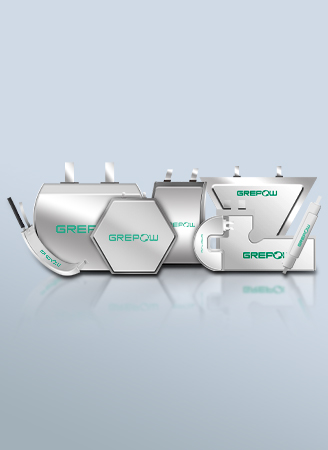
Grepow also offers multi-dimensional battery customization, covering cell chemistry, form factor, BMS architecture, and interface design. Each solution is precisely matched to specific application requirements, balancing safety, stability, and long service life to provide a solid and dependable energy foundation for aerial platforms and professional equipment.
Looking ahead, Grepow will continue to prioritize safety and reliability, delivering trusted power solutions for increasingly demanding applications—on the ground, in the air, and beyond.


Related Articles
-
Join Grepow at EUHA 2025: Discover the Next Generation of Ultra-Thin Hearing Aid Batteries
2025-10-22 -
Powering the Future of Wearables: How Grepow's Patented Curved Battery is Revolutionizing the Smart Ring
2025-10-16 -

AI Toys Leap into Innovation: Why Battery Choice Matters
2025-09-26
Related products
-
380Wh/kg Series Semi-Solid State High Energy Density Battery Pack
-

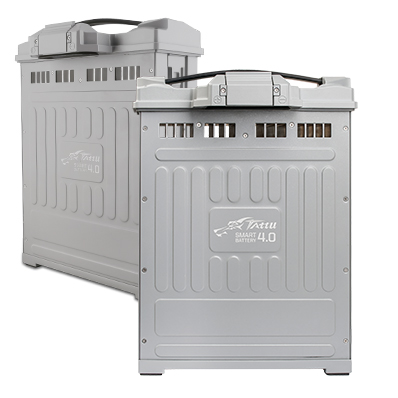
Tattu 12S LiPo Drone Battery Series
-

350Wh/kg Series Semi-Solid State High Energy Density Battery Pack
Comment(0)
Comment( Your email address will not be disclosed. Required fields are marked as * )