

2 weeks later, Grepow will meet product developers, engineers, purchasing teams, and industry partners at two exhibitions serving very different technology markets: CEATEC 2026 in Japan and the 70th International EUHA Congress & Exhibition in Germany.

CEATEC 2026 will take place from October 13 to 16 at Makuhari Messe in Chiba under the theme "Transformation - Where Companies, Industries, and Society Evolve." The exhibition brings together technologies and businesses from across industries to explore new products, partnerships, and applications. (CEATEC 2026 Official Website: Event Outline)
One day later, EUHA 2026 opens in Hannover. The 70th International Congress of Hearing Aid Acousticians will run from October 14 to 16 at Deutsche Messe Hannover, bringing together the international hearing care community, technical specialists, and hearing system companies. (EUHA: 70th International Congress of Hearing Aid Acousticians)
The applications are different, but many of the battery engineering questions are surprisingly similar. As electronics become smaller and more wearable, available battery space is often thin, narrow, curved, circular, or interrupted by other components. At both exhibitions, we will focus on rechargeable battery designs that make better use of these constrained spaces.
Meet Grepow at CEATEC 2026 in Japan

We will exhibit at Hall 8, Booth 8H317 at Makuhari Messe. Grepow is listed in CEATEC's General Exhibits area, where companies present technologies, products, and solutions related to emerging industries and future applications. (CEATEC 2026 Official Website: Exhibitor List)
Custom-Shaped Pouch Batteries for New Device Architectures
Many next-generation electronics do not provide a clean rectangular cavity for the battery. Frames, sensors, circuit boards, hinges, antennas, cameras, and mechanical structures can divide the remaining internal space into irregular areas.
This is where we see a strong role for custom-shaped pouch cells.
Our shaped battery portfolio includes curved, round, D-shaped, U-shaped, stepped, polygonal, and other customized geometries. Rather than designing a device enclosure around an off-the-shelf rectangular cell, developers can evaluate whether the cell geometry itself can follow more of the available space.
At CEATEC, we expect this discussion to be especially relevant for teams developing:
AI glasses and smart eyewear
Smart rings and compact health wearables
AI recording devices
AR/VR hardware
Sensor-based wearable electronics
Compact connected devices
New consumer electronics with unconventional internal structures
Ultra-Thin Batteries When Thickness Is the Limiting Dimension
Some products have sufficient surface area but almost no room in the Z-axis. In these designs, reducing battery thickness can be more important than reducing its overall footprint.
Our ultra-thin rechargeable pouch cells can be manufactured down to approximately 0.5 mm in selected designs, with different dimensions, capacities, and full-charge voltages available according to project requirements.
This format is worth discussing for slim wearable electronics, card-like devices, lightweight sensors, compact medical electronics, and other products where enclosure thickness leaves little room for a conventional cell.
The point is not simply to make the battery thinner. A useful design must balance the available footprint, target capacity, operating profile, mechanical requirements, and the amount of space that can realistically be assigned to the battery.
Ultra-Narrow Batteries for Long, Restricted Spaces
Other devices have the opposite problem: thickness is manageable, but the available battery area is extremely narrow.
Smart glasses are a good example. Much of the usable battery space may be distributed along narrow temples rather than concentrated in a large central cavity.
Grepow's ultra-narrow pouch battery range includes cell widths down to approximately 4 mm in existing models, with different thicknesses and lengths available for product integration. Our ultra-narrow platform is intended for projects where conventional cell width would leave usable internal volume inaccessible.
At our CEATEC booth, visitors can bring drawings, target dimensions, or early enclosure concepts and discuss whether an ultra-narrow, ultra-thin, curved, or other shaped cell is the more practical direction.
Shaped Cells When a Round Battery Leaves Space Unused
A coin cell is not automatically the right answer for every hearing product.
When the enclosure curves around other components, or when available battery space is narrow or asymmetric, a shaped pouch or miniature shaped metal-casing cell may allow the battery to occupy a more useful portion of the available cavity.
That design principle is not new to hearing-aid engineering. Rechargeable lithium-ion cells have long been investigated specifically in hearing-aid-compatible sizes because both electrochemical performance and physical compatibility with the hearing device matter at the same time. (Journal of Power Sources: Lithium-Ion Batteries for Hearing Aid Applications)
For projects at an earlier mechanical-design stage, this opens a useful discussion: instead of choosing the battery only after the enclosure is finalized, battery geometry can be considered while the internal layout is still flexible.
For CEATEC visitors, this creates another option to compare alongside shaped pouch cells rather than treating every compact device as the same battery problem.
Meet Grepow at EUHA 2026 in Germany

At Booth 129 in Hannover, our focus will shift toward the much smaller scale of hearing devices and related compact electronics.
EUHA 2026 is expected to bring together more than 140 international exhibitors alongside expert lectures, tutorials, startup presentations, and the EUHA Live Area in Hall 6. The event is centered on the hearing care industry rather than general consumer electronics, which makes it a valuable setting for much more application-specific battery discussions. (EUHA: EUHA 2026 Industry Countdown)
Battery Design for Smaller Hearing Devices
A hearing device does not give the battery much room to hide.
Battery volume competes with acoustic components, processing electronics, wireless connectivity, mechanical structures, and the enclosure itself. At the same time, the finished device must remain comfortable and practical for daily wear.
Battery power also has to match the real operating profile of the electronics. Research on a rechargeable behind-the-ear hearing platform, for example, showed measurable runtime differences depending on whether wireless interfaces were active, illustrating how additional electronic functions can directly affect the device's energy budget. (PubMed: Low-Power Research Hearing Aid Study)
This is why we prefer to discuss hearing-device batteries from the product architecture outward rather than beginning with a fixed capacity number.
Rechargeable Coin Cells for Very Small Devices
Rechargeable coin cells remain an important format for compact hearing products because their circular geometry fits naturally into many miniature device architectures.
Our current hearing-aid battery portfolio includes rechargeable lithium-ion coin cells from 7.8 mm in diameter, along with shaped pouch and shaped metal-casing options for projects where a conventional circular cell does not make the best use of the enclosure. Existing models cover different diameters, heights, capacities, and nominal voltages, allowing development teams to compare more than one battery architecture during early design. (Grepow: Rechargeable Hearing Aid Battery Solutions)
At EUHA, we want to discuss these choices in terms of the actual device, not simply present a row of cell specifications.
Metal-Casing Shaped Batteries for Compact, Shape-Constrained Products
We will also present metal-casing shaped rechargeable batteries.
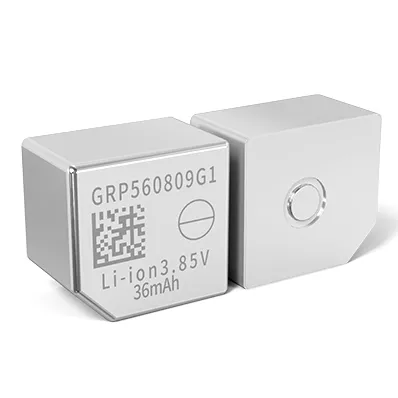
These cells extend customization beyond conventional rectangular packages with shapes such as arc, oval, pentagonal, quadrilateral, C-shaped, D-shaped, crescent, and circular stepped designs. Our current metal-casing platform supports custom dimensions and several voltage options, with selected designs starting from approximately 3.5 mm in thickness and 6 mm in width. (Grepow: Metal-Casing Shaped Rechargeable Battery)
They are especially relevant when a development team needs tighter dimensional control and a cell structure that follows a defined product cavity.
Ultra Small Battery Portfolio, Different Product Challenges
CEATEC and EUHA serve different industries, so we are not bringing one generic battery message to both exhibitions. What connects them is the engineering constraint: fitting reliable rechargeable power into products where internal space is increasingly limited by thickness, width, curvature, or other mechanical structures.
| Product Design Challenge | Grepow Battery Direction | Example Applications |
|---|---|---|
| Irregular internal cavity | Custom-shaped pouch cell | AI wearables, compact electronics |
| Very limited thickness | Ultra-thin pouch cell | Slim wearables, sensors, thin smart devices |
| Long and narrow enclosure | Ultra-narrow pouch cell | Smart glasses, compact connected devices |
| Curved or annular structure | Curved or other shaped cell | Smart rings, wearable electronics |
| Very small circular space | Rechargeable coin cell | Hearing devices, miniature electronics |
| Precisely defined non-rectangular cavity | Metal-casing shaped cell | Hearing products, medical and wearable devices |
Our shaped battery portfolio already covers ultra-thin, ultra-narrow, curved, round, U-shaped, D-shaped, polygonal, and other structures, with customization available around dimensions and project requirements.
The right choice depends on what is actually limiting the product: thickness, width, curvature, available volume, runtime, charging requirements, mechanical structure, or a combination of several factors.
Bring Your Device Constraints to Our Booth
If you are developing a new wearable, hearing device, AI product, medical electronic device, or another compact system, you do not need to arrive at our booth with a finished battery specification.
In many cases, the more useful starting point is the device constraint itself. Bring us information such as:
Available battery space and maximum dimensions
CAD drawings or enclosure geometry
Required operating voltage
Target capacity or runtime
Average and peak current requirements
Charging requirements
Device operating environment
Prototype or development stage
Expected production volume
Our team can then discuss which direction deserves further evaluation: a conventional small cell, ultra-thin or ultra-narrow pouch cell, custom-shaped pouch design, rechargeable coin cell, or metal-casing shaped battery.
This is also why we are bringing several battery structures to CEATEC and EUHA rather than focusing on a single cell format. Product teams at these exhibitions are solving different problems, and we want the battery discussion to begin with the product they are actually building.
Visit Grepow at CEATEC 2026 & EUHA 2026
If you will be in Japan or Germany this October, we welcome you to visit our team and see the batteries in person.
CEATEC 2026
Date: October 13-16, 2026
Venue: Makuhari Messe, Chiba, Japan
Grepow Booth: Hall 8, 8H317
CEATEC requires visitor pre-registration, and the official visitor site is available for attendees planning their visit. (CEATEC 2026 Official Website: Visitor Guide)
70th International EUHA Congress & Exhibition
Date: October 14-16, 2026
Venue: Deutsche Messe Hannover, Germany
Grepow Booth: 129
Whether you already have a battery specification or are still trying to fit more runtime into a difficult enclosure, bring the project to us. We look forward to discussing how battery shape, dimensions, electrical requirements, and product structure can be considered together.
Two exhibitions. Different applications. Visit Grepow and talk about the battery your next device actually needs.
FAQ
What kinds of batteries can I see at Grepow's CEATEC 2026 booth?
We will showcase custom-shaped pouch cells, ultra-thin and ultra-narrow batteries, curved batteries, and button cells. These formats are designed for compact electronics such as AI wearables, smart glasses, smart rings, and other space-constrained devices.
Will Grepow show rechargeable batteries for hearing aids at EUHA 2026?
Yes. Our EUHA display will include rechargeable coin cells, miniature shaped pouch batteries, and shaped metal-casing cells suitable for hearing devices and other compact electronics. You can meet us at Booth 129.
Can Grepow customize a battery around the available cavity in our hearing device or AI wearable?
Yes. We can evaluate the available dimensions, enclosure geometry, voltage, capacity, current profile, and charging requirements before recommending a battery structure. Depending on the project, this may include ultra-thin, ultra-narrow, curved, irregular pouch, coin-cell, or metal-casing designs.
Which battery format should we consider if device width or thickness is the main mechanical constraint?
For very thin enclosures, an ultra-thin pouch cell may be appropriate; for long, narrow spaces, an ultra-narrow design may use the cavity more effectively. Irregular or curved spaces may instead benefit from a custom-shaped pouch or metal-casing cell.
What information should our engineering team bring to discuss a custom battery project at the exhibition?
Bring your available battery dimensions or CAD geometry, required voltage, target runtime or capacity, current profile, charging requirements, operating conditions, and project stage. These details help us evaluate viable cell formats and identify the next steps for sampling and validation.