














Quick Answer: What Is the Main Difference Between OWS and TWS Earbuds?
OWS and TWS are not exact opposites. TWS describes a wireless stereo architecture, while OWS describes an open-wear form factor that does not seal the ear canal. In everyday comparisons, however, "TWS" usually means conventional in-ear or semi-in-ear earbuds, while "OWS" means open-ear products such as ear-hook and ear-clip earbuds.
For the user, the main differences involve fit, environmental awareness, isolation, sound presentation, and suitable listening scenarios. For us as a battery manufacturer, the more important differences are battery placement, usable space, cell shape, weight distribution, acoustic power demand, and charging-case design. Neither category automatically provides longer runtime.
Introduction: The User Experience Starts with the Wearing Structure
Consumers usually compare OWS and TWS earbuds by asking which is more comfortable, which sounds better, or which lasts longer. At Grepow, we look one level deeper. The wearing structure determines where the speaker, battery, PCB, microphones, antenna, and charging contacts can be placed. It also affects how much battery weight the ear can comfortably support.
This distinction is becoming more relevant as OWS expands beyond sports products. Omdia reported that OWS shipments reached 11.1 million units in the second quarter of 2026, up 12% year over year, while conventional TWS shipments declined 2%. Omdia also classifies both clip-on and ear-hook OWS products within the wider TWS market, confirming that the two terms describe different aspects of an earbud rather than mutually exclusive technologies. (Omdia: OWS Shipments Grow as the TWS Market Remains Broadly Flat)

TWS and OWS Are Not Strictly Opposite Categories
True Wireless Stereo refers to separate left and right earbuds that reproduce synchronized stereo audio without a cable between them. The Bluetooth SIG notes that the term became widely established for products in which the two earbuds coordinate a stereo stream wirelessly. An open-ear product can therefore be both OWS and TWS. (Bluetooth SIG: Introducing Bluetooth LE Audio)
| Category | Main Meaning | Typical Product Form |
|---|---|---|
| Conventional TWS | A true wireless product with an in-ear or semi-in-ear structure | Compact earbuds placed in or near the ear canal |
| OWS | An open-wear product that leaves the ear canal unobstructed | Ear-hook, ear-clip, ear-cuff, or open-ring earbuds |
For clarity, we use "TWS" below as shorthand for conventional in-ear and semi-in-ear TWS earbuds. This reflects how most consumers phrase the comparison, even though many OWS products also use a true wireless architecture.
OWS vs TWS Earbuds from the User’s Perspective
The visible differences begin with how the product interacts with the ear. Neither design is universally better; each prioritizes a different balance of awareness, isolation, stability, sound, and long-wear comfort.
Fit, Comfort, and Environmental Awareness
Conventional TWS earbuds sit in the ear canal or at its entrance. A well-fitted ear tip can provide a stable seal and reduce outside sound, but comfort depends heavily on ear shape, tip size, and insertion pressure. OWS earbuds leave the canal open and support the product with a hook, clip, cuff, or another external structure.
A 2026 human-factors study found that open-ear headphones allowed users to combine personal audio with environmental sound, supporting situational awareness and social interaction in everyday settings. The same study also identified practical fit variables such as hair, piercings, posture, and differences between individual ears. (Proceedings of the Human Factors and Ergonomics Society: Open-Ear Headphones as Ambient Interfaces)
Isolation, Bass, and Sound Leakage
An in-ear seal helps a conventional TWS earbud control low-frequency sound. The Audio Engineering Society reported that even a small leak in an insert earphone can produce a substantial reduction in bass response. This helps explain why ear-tip fit has such a strong effect on perceived TWS sound quality. (Audio Engineering Society: Acoustic Seal Performance Tests for Insert Earphones)
OWS products do not use that seal. Their acoustic design must direct sound toward the ear while managing losses to the surrounding air. Sound leakage is not unavoidable at the same level in every design, but it is an engineering concern. An IEEE study demonstrated that enclosure geometry and opposite-phase radiation can materially reduce leakage from a compact open-ear headphone, showing that the result depends on acoustic design rather than the "open" label alone. (IEEE Access: Designing an Open-Back Enclosure to Mitigate Sound Leakage)
| Consumer Consideration | Conventional TWS | OWS Earbuds |
|---|---|---|
| Ear-canal contact | In-ear or near the canal | The ear canal remains open |
| Environmental awareness | Depends on isolation and transparency mode | Ambient sound enters naturally |
| Low-frequency response | Can benefit from a controlled acoustic seal | Requires careful driver positioning and acoustic tuning |
| Sound leakage | Generally easier to contain | More dependent on distance, direction, volume, and enclosure design |
| Typical use | Private listening, commuting, and noisy environments | Sports, office use, calls, and awareness-focused listening |
OWS vs TWS Battery Requirements at a Glance
The wearing and acoustic differences create different battery priorities. The table below summarizes the typical pattern we see when evaluating earbud projects. It is a design guide, not an absolute rule for every product.

| Battery Factor | Conventional TWS | OWS |
|---|---|---|
| Available space | Compact and concentrated | More distributed and often irregular |
| Typical battery position | Inside the main rigid earbud body | Rear pod, comfort bean, or another rigid module |
| Common cell shape | Round or compact rectangular | Round, narrow, curved, stepped, or custom-shaped |
| Main mechanical concern | Miniaturization and assembly tolerance | Weight balance, torque, and protected placement |
| Power consideration | Codec, ANC, transparency, calls, and sensors | Acoustic output, calls, sensors, and smart functions |
| Charging case | Compact earbud positioning | More complex storage and contact alignment |
How Battery Placement Differs Between TWS and OWS Earbuds
A product may appear large from the outside but still provide very little usable battery volume. Speaker chambers, structural ribs, antennas, microphones, PCBs, flexible circuits, and charging contacts all compete for the same space.
Compact Placement in Conventional TWS Earbuds
A conventional TWS earbud usually concentrates its electronics inside one small rigid housing. A round cavity may suit a rechargeable button cell, while a stem or wider body may use a compact pouch cell. The battery must fit around the driver and PCB without interfering with the antenna or microphone path.
This regular geometry allows many projects to begin with an existing cell rather than a custom design. Grepow’s TWS earbud battery solutions, for example, include rechargeable button cells for compact, protected earbud cavities.
Distributed Placement in OWS Earbuds
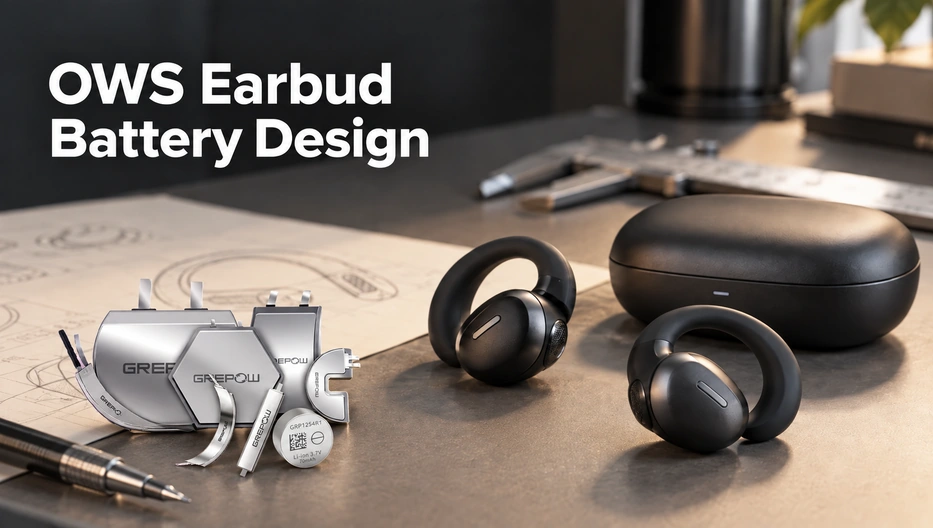
An ear-hook OWS product may place the speaker near the ear opening and the battery behind the ear. An ear-clip design may divide its electronics between a front acoustic module and a rear support module. These layouts can create longer or less regular battery envelopes, but they also make weight distribution more important.
The flexible hook or bridge should normally carry wiring or an FPC rather than serve as a repeatedly bending battery zone. We prefer to place the cell in a rigid, mechanically protected section with room for manufacturing tolerance and expected swelling. Research on OWS comfort likewise emphasizes external-ear dimensions and product geometry, reinforcing that wearable fit must be evaluated around real ear shapes rather than a single nominal model. (Applied Human Factors and Ergonomics: Designing for OWS Earphone Comfort)
Cell Shape, Capacity, and Weight Priorities
OWS housings often look larger than conventional earbuds, but the available volume may be fragmented. A long ear hook, for example, still needs space for structural support, wiring, sealing, and compatibility with glasses. A larger external outline does not guarantee a larger cell.
When a Standard Cell Is Enough
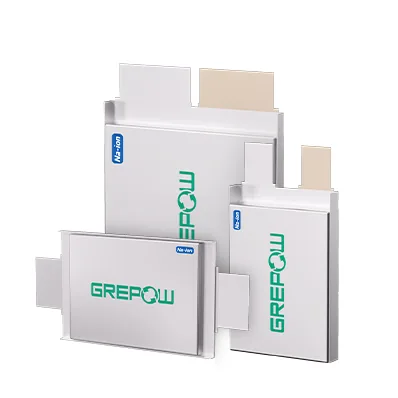
A standard rechargeable button cell or micro pouch cell is usually the practical starting point when the battery compartment is rigid and regular. Existing cells reduce early tooling risk and make it easier to test runtime, voltage sag, temperature, and product balance before the enclosure is finalized.
When a Custom Shape Becomes Useful
A custom-shaped cell becomes relevant when a standard rectangle leaves significant unused space, interferes with another component, or forces the battery too far from the ear’s support point. Narrow, curved, stepped, or other non-rectangular cells can improve space utilization, but they cannot compensate for excessive system power consumption.
Our OWS earbud battery design guide explains how we compare rechargeable button cells, metal-cased shaped cells, and custom pouch cells after the battery envelope and power profile have been defined.
Why Open-Ear Acoustics Change the Power and Runtime Equation
It is tempting to say that OWS always consumes more power because the ear canal is open. That is too simple. Acoustic output matters, but so do the codec, radio conditions, microphones, sensors, ANC, voice processing, and firmware.

Audio Architecture Matters More Than the Product Label
An OWS device may require greater amplifier output at higher listening levels or in a noisy environment. A conventional TWS product may add continuous ANC, transparency processing, or several active microphones. Bluetooth LE Audio can improve the trade-off between audio quality and power through the LC3 codec, but the Bluetooth SIG notes that actual power reduction depends on the implementation and how the product uses the available efficiency. (Bluetooth SIG: Bluetooth LE Audio FAQs)
Runtime Must Be Calculated Across Operating Modes
Music playback, calls, standby, voice detection, and translation do not draw the same current. We therefore ask customers for the average and peak current of each relevant mode instead of sizing the cell from one headline runtime. Texas Instruments recommends calculating battery life from time spent in different operating states and warns that low-load periods should not be ignored when they occupy a large share of the duty cycle. (Texas Instruments: Battery Life and Power-Conversion Efficiency)
Published runtime should also be treated as a test result, not a fixed property of the category. Huawei, for example, specifies the codec, volume, ambient temperature, and enabled features behind its FreeClip battery-life figures. Different conditions can produce different results even when the battery capacity is unchanged. (Huawei FreeClip Specifications)
OWS vs TWS Charging Case Requirements
Both product types need a charging case sized around the energy of two earbuds, the desired number of recharges, and the measured transfer efficiency. Case capacity alone does not reveal how much usable energy reaches the earbuds.
Conventional TWS earbuds are generally easier to position in a compact molded cavity. Ear-hook and ear-clip OWS products may require a larger case, more complex folding or nesting, and tighter control of magnet force and charging-contact alignment. Sweat on the contacts, left-right placement, standby consumption, LEDs, displays, and wireless charging can further reduce usable case energy.
Fast charging is also a system specification. The cell, charging IC, contact resistance, firmware, and case temperature all affect the result. In an ear-worn device, we recommend checking temperature both during charging and immediately after the earbuds are removed from the case.
In-device X-ray research on commercial wireless earbuds found that uneven temperatures from neighboring electronics contributed to localized battery degradation, demonstrating why standalone cell testing cannot replace validation inside the assembled product. (Stanford Synchrotron Radiation Lightsource: In-Device Battery Failure Analysis)
Which Battery Architecture Fits Your Earbud Project?
We do not select an earbud battery from the OWS or TWS label alone. We begin with the protected battery space, mode-based power profile, target runtime, maximum earbud weight, and charging requirement.
Compact in-ear TWS with a round cavity: Start with a rechargeable button cell.
TWS with a regular rectangular or stem-shaped cavity: Evaluate a compact pouch cell.
Ear-hook OWS with a rigid rear pod: Test an existing narrow cell before opening custom tooling.
Ear-clip or ear-cuff OWS with an irregular cavity: Compare shaped metal-cased and custom pouch options.
OWS with multiple microphones or local processing: Measure mode-based average and peak loads before fixing capacity.
A custom shape is justified when it delivers a measurable benefit in capacity, component clearance, weight distribution, or enclosure thickness. It should not be added only because a product is described as OWS.
Conclusion
From a consumer perspective, conventional TWS favors isolation and compactness, while OWS favors an open ear canal and natural access to surrounding sound. From our battery perspective, the real distinction is concentrated space versus distributed space.
TWS projects often prioritize miniaturization inside a regular rigid cavity. OWS projects add stronger constraints around cell position, irregular geometry, weight balance, acoustic power, and charging-case layout. Neither category guarantees better battery life. Reliable selection starts with the actual battery envelope and measured power modes.
Developing a TWS or OWS earbud? Share your available battery space, target runtime, weight limit, charging requirement, and measured power profile with Grepow. We can evaluate existing ultra-small cells or a custom-shaped battery solution for your device.
FAQ
Is OWS better than TWS for everyday use?
It depends on where and how you listen. OWS suits users who value environmental awareness and an open ear canal, while conventional TWS is often better for isolation, private listening, and noisy environments.
Do OWS earbuds normally last longer than TWS earbuds?
Not automatically. OWS may provide a different battery envelope, but runtime still depends on usable energy, listening volume, acoustic output, microphones, wireless conditions, processing features, and the manufacturer’s test conditions.
How should we compare battery capacity between an OWS prototype and an in-ear TWS design?
Compare watt-hours and usable energy rather than mAh alone. Build a mode-based power profile, then include conversion losses, cutoff voltage, temperature, aging margin, and peak-load voltage sag.
When does an OWS project require a custom-shaped cell instead of a standard button or pouch cell?
Consider customization when a standard cell wastes critical space, blocks another component, creates poor weight balance, or cannot meet capacity within the permitted thickness. Test the closest standard sample first whenever possible.
How should local processing, multiple microphones, or smart functions affect an OWS battery specification?
Measure their duty cycles, average current, and peak current separately from music playback. The battery and charging case should be sized around the expected mix of operating modes, not the product’s feature list alone.