











Quick Answer
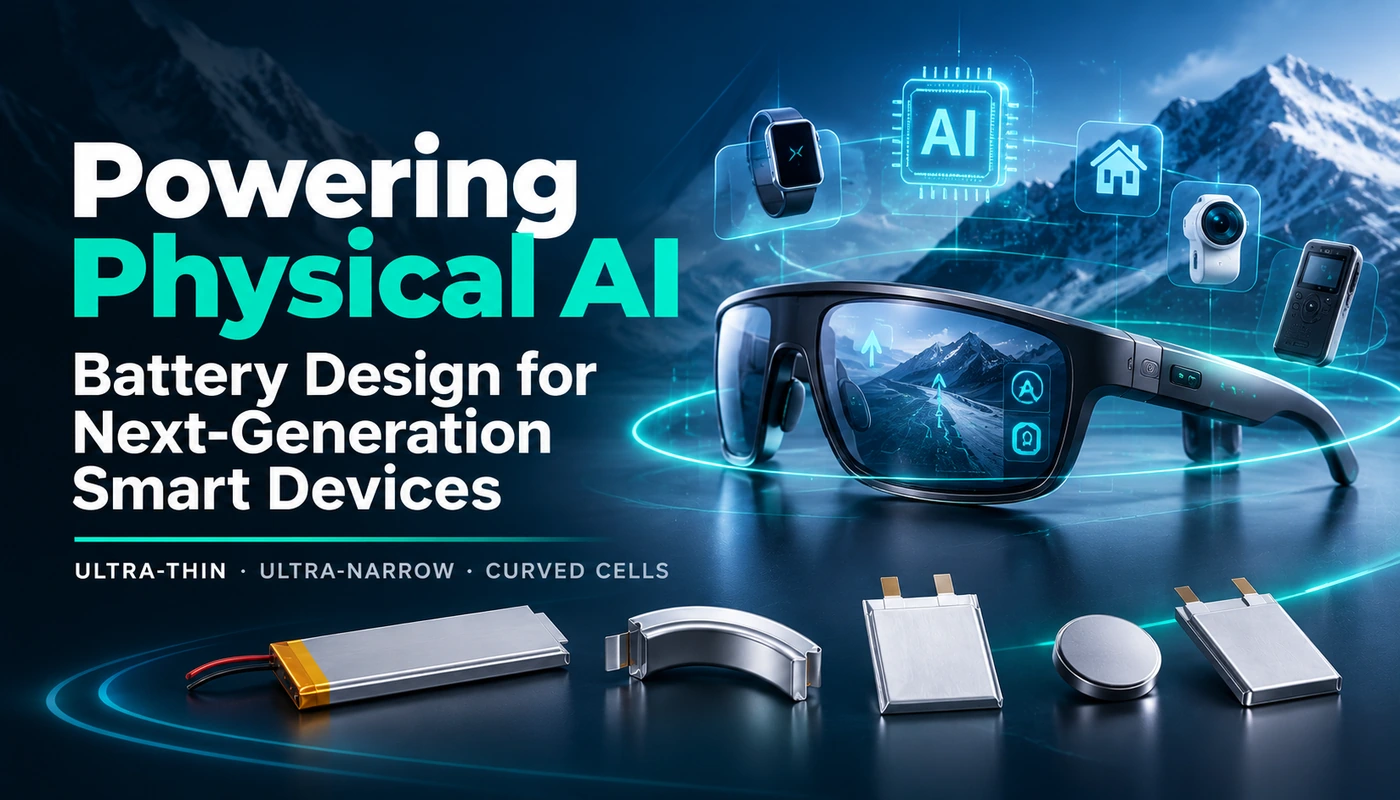
Designing ultra-small batteries for AI OWS open-ear earbuds starts with the wearable structure and multi-mode power budget instead of picking a mAh rating first. For applications with limited space or requiring irregularly shaped batteries, Grepow offers rechargeable button cells, metal-cased irregular-shaped batteries, and custom pouch batteries; stacked-cell construction can reduce inactive space and boost capacity within the same tiny footprint. Thermal management, weight balance, mechanical stress and charging contact reliability must be validated at the device level. The workflow: define battery envelope → power profiles → screen off-the-shelf samples → test voltage sag and heat → decide whether custom cell tooling is needed.
Introduction
Open ear earbuds, often described as earbuds that don't go in your ear, are moving beyond sports into calls, translation, voice assistance, and all-day audio. Omdia reported that OWS shipments reached 11.1 million units in Q2 2026, up 12% year over year, and expects smarter features to support further adoption. (Omdia, September 17, 2026)

Battery Design for OWS Earbuds Starts with the Wearing Structure
OWS is not one mechanical format. Ear hook headphones, open ear clip earbuds, ear-cuff, open-ring, and jewelry-style devices distribute their electronics differently, so each creates a different battery envelope.
Ear hook headphones and rear-pod designs
Earbuds that wrap around the ear can place the battery behind the ear, where a longer cell may help balance the front acoustic module. The battery still belongs in a rigid, protected pod. The flexible bridge or hook should carry wiring or an FPC, not bend a conventional lithium-ion cell.
Clip on earbud headphones, ear cuffs, and earring headphones
Open ear clip earbuds and earring headphones have less forgiving geometry. A battery near the rear module can counterbalance the speaker, but every added gram increases pressure or torque at the contact point. Huawei's FreeClip 2 shows the direction of travel: each earbud weighs 5.1 g while integrating an NPU AI processor, adaptive audio functions, and a clip-on structure. (Huawei FreeClip 2)
Speakers, antennas, microphones, contacts, and structural ribs compete for volume. We therefore ask customers to identify the protected battery zone in a 2D drawing or 3D file before discussing capacity.
Build the Power Budget Before Selecting Capacity
OWS wireless headphones do not draw one steady current. Music playback, calls, wake-word detection, translation, adaptive volume, voice enhancement, sensors, and radio retransmissions create different average and peak loads.
Start by separating the base load from optional features:

| Operating block | Typical design question |
|---|---|
| Bluetooth audio and codec | Which codec, bitrate, RF conditions, and retransmission rate are expected? |
| Speaker and amplifier | What volume level and acoustic output define the runtime claim? |
| Microphones and calls | How many microphones remain active during calls or voice capture? |
| Sensors and controls | Are touch, IMU, wear detection, or health sensors always on? |
| AI processing | Does inference run in the earbud, on a phone, in the cloud, or across all three? |
Bluetooth LE Audio can improve the system-level trade-off between audio quality and power through the LC3 codec, but actual savings still depend on the radio, firmware, codec settings, and use case. (Bluetooth SIG)
Not all OWS AI translator earbuds need the same battery
App- or cloud-led OWS AI translator earbuds may use the earbud mainly for audio capture and playback. An on-device design adds sustained DSP or NPU activity and may raise both average current and heat. A hybrid design sits between them. The label "AI earbud" is therefore not a battery specification; the processing location and duty cycle are.
Convert Runtime into a Real Capacity Target
For a first estimate at one nominal voltage:
Required capacity (mAh) = average current (mA) × target runtime (h) ÷ usable-capacity factor
The average current should be mode-weighted. For example, a product used for six hours of music, one hour of calls, and one hour of intermittent translation should not be sized from music current alone. Texas Instruments likewise calculates battery life from average current across operating scenarios rather than from a single active-state number. (Texas Instruments application report)
The usable-capacity factor should account for cutoff voltage, efficiency, temperature, aging, and peak-load voltage sag. When nominal voltages differ, compare watt-hours rather than mAh alone and confirm charger and power-path compatibility.
Choose the Cell Architecture Around the Available Space
Once the power target is credible, we evaluate three practical cell families for ultra-small open earbuds and OWS earphones.

Rechargeable button cells
Button cells suit compact round or near-round rigid cavities. Grepow's rechargeable range starts at 7.8 mm in diameter and 6.5 mAh, with size, voltage, and shape customization available. The product family advertises fast-charge capability up to 5C, but the approved rate must be confirmed for the selected model rather than applied to the whole range. (Grepow rechargeable button cells)
Metal-casing shaped cells
A shaped steel enclosure can follow a non-round rigid cavity while providing dimensional stability. Grepow lists designs as thin as 3.5 mm and as narrow as 6 mm, with 3.7 V to 3.9 V options. (Grepow metal-casing shaped batteries)
Custom-shaped pouch cells
Pouch construction offers the greatest freedom for curved, stepped, or non-rectangular cavities. Grepow's range supports thicknesses down to 0.5 mm and widths down to 6 mm, although its public tables do not show a stock pouch cell within a strict 12 × 12 × 4 mm box. Such projects require custom feasibility work. (Grepow shaped pouch batteries)
Why Stacked-Cell Construction Matters Below 10 mm
At very small dimensions, inactive space becomes a larger percentage of the cell. Electrode bends, tabs, seals, and manufacturing tolerances can consume volume that would otherwise hold active material.
For qualified projects with cell length and width below 10 mm and thickness below 4 mm, our engineering team can evaluate a stacked construction. Flat electrode layers may use a compact enclosure more effectively than a wound architecture and can create capacity headroom within the same battery envelope. Independent cell-format research also shows that stacked pouch cells can behave differently in resistance, rate capability, and degradation, so the architecture must be validated rather than treated as universally superior. (University of Warwick and University of Birmingham study)
"Potential" matters. The final gain depends on chemistry, electrode loading, tab layout, sealing width, current requirement, protection, and production tolerances.
Ultra-Small Sample Kit Candidates
The following public Grepow models meet a strict maximum envelope of 12 mm in length or diameter, 12 mm in width, and 4 mm in thickness. Dimensions are cell dimensions as published; tabs, leads, connectors, protection, and assembly tolerances can enlarge the required device space.
| Model | Construction | Published dimensions | Nominal voltage | Capacity | Published rate / fast-charge data |
|---|---|---|---|---|---|
| GRP7820R1 | Rechargeable steel coin cell | Ø7.8 × 2.0 mm | 3.7 V | 6.5 mAh | 1C max charge |
| GRP7840M1 | Rechargeable steel button cell | Ø7.8 × 4.0 mm | 3.7 V | 20 mAh | 1C published rate |
| GRP8525R1 | Rechargeable steel coin cell | Ø8.5 × 2.5 mm | 3.7 V | 9.5 mAh | 1C max charge |
| GRP9525R1 / G1 | Rechargeable steel coin cell | Ø9.5 × 2.5 mm | 3.7 / 3.85 V | 12.3 / 14.5 mAh | 1C published rate |
| GRP1025R1 / N1 | Rechargeable steel coin cell | Ø10 × 2.5 mm | 3.7 / 3.9 V | 13 / 16 mAh | 1C charge/discharge |
| GRP1224 series | Rechargeable steel coin cell | Ø12 × 2.4 mm | 3.7 V | 18-22 mAh | 0.5C, 2C, or 5C by variant |
| GRP400609G1 | Arc-shaped stainless-steel cell | 4 × 6 × 9 mm | 3.85 V | 18 mAh | 1C fast charge |
This table is a starting point, not an approved BOM. Inventory, U.S. sample availability, certification, lead configuration, and current specifications require confirmation. Early tests can combine locally available samples with custom-form-factor evaluation before a new cell design is committed.
Control Heat, Weight Balance, and Mechanical Stress
In an ear-worn product, battery placement changes both comfort and reliability. Torque rises with mass and distance from the support point, so a lighter cell in a better location can outperform a larger cell that makes the device rotate or clamp harder.
Heat also needs device-level validation. A 2025 in-device study of commercial wireless earbuds found that battery degradation was shaped by the interaction of materials, cell structure, and the device microenvironment, including temperature gradients and fluctuations. (SLAC/Stanford Synchrotron Radiation Lightsource) We recommend checking steady audio, calls, AI-on modes, fast charging, immediate wear after charging, and wireless-case charging if used.
Keep the cell in a rigid protected region with appropriate tolerance and swelling allowance. Test drops, hook or clip cycles, compression, FPC tension, sweat ingress, and adhesive aging in the assembled device.
Design the Charging Case as Part of the Energy System
Size the case from the energy of both earbuds, desired recharge count, and measured transfer efficiency. Include standby current, boost and charging losses, contact resistance, displays, wireless charging, and aging.
OWS geometry can make contact alignment harder than it is in a compact in-ear bud. Prototype testing should cover left/right insertion, magnet force, pogo-pin tolerance, contamination from sweat, case closure, and charging after a drop. Fast top-up claims should be verified at the worst expected cell temperature and state of charge, not only at room-temperature bench conditions.
Move from Samples to a Production-Ready Battery
For useful sample screening, share the form factor, maximum space, target runtime, weight limit, average and peak current, charge current, AI processing location, temperature range, tab requirement, project stage, and annual volume.
Our recommended path is straightforward: define the envelope and power modes, screen existing cells, test the closest samples, confirm voltage sag and temperature in the device, then decide whether a custom button, shaped steel, or shaped pouch cell is justified. This reduces the risk of opening custom tooling before the system assumptions are stable.
For teams developing OWS earbuds, earring headphones, ear clip headphones, or other miniature wearables, Grepow can provide a wide selection of ultra-small batteries, locally available U.S. samples for selected models, fast sample support, and custom form-factor evaluation. Send us your available battery space, target runtime, weight limit, charging requirement, and measured power profile to begin.
FAQ
Will a higher mAh number always make my open earbuds last longer?
No. Runtime also depends on voltage, listening volume, calls, radio conditions, AI functions, conversion efficiency, and cutoff settings. Compare tested runtime under the same operating mode, not mAh alone.
Can AI features drain my earbuds even when I am not playing music?
Yes, if microphones, wake-word detection, sensors, or on-device processing stay active. App- or cloud-led features may shift more processing to the phone, so the effect depends on the product architecture.
For a battery envelope below 10 × 10 × 4 mm, when should we evaluate a stacked cell instead of a wound design?
Evaluate stacking when inactive corner volume, electrode bends, or rate performance limit the wound design. Capacity improvement is project-specific and must be confirmed after chemistry, tabs, seals, current, and tolerance requirements are fixed.
How should we choose between a rechargeable button cell, a metal-casing shaped cell, and a custom pouch cell for OWS headphones?
Use the cavity geometry and mechanical risk first. Button cells fit round rigid spaces, shaped steel cells suit compact non-round protected cavities, and pouch cells provide the most outline freedom but require careful restraint, swelling allowance, and puncture protection.
What information does Grepow need to recommend samples for an AI ear-worn prototype?
Provide maximum cell dimensions or a 3D file, target runtime, mode-based average and peak current, voltage limits, charging target, weight limit, temperature range, tab or connector needs, project stage, and expected volume. Also state whether AI runs locally, on a phone, or in the cloud.