













Quick Answer
At the 2026 Hong Kong Electronics Fair, we saw fewer entirely new product categories than new interpretations of familiar wearables. Smart glasses were being adapted for sports, wristbands were becoming simpler, smart rings were splitting into health and control products, and electronics were moving into earrings, pendants, and badges.
For manufacturers, the opportunity is no longer just adding more features. It is building a device that fits a specific activity, wearing position, and user habit. This also changes the battery question: capacity still matters, but geometry, weight, power profile, charging method, and system layout increasingly determine whether a product feels practical.
This direction is consistent with IDC's assessment that smart glasses and rings are among the fastest-growing emerging wearable categories, while screenless health bands are establishing a more defined niche. (IDC: Wearable Devices Market Insights)

What We Looked for at the Show
We attended the 2026 Hong Kong Electronics Fair to look beyond product launches and identify where consumer electronics may be heading next.
From Grepow's perspective as a battery manufacturer, the most useful question was not, "Which product attracted the biggest crowd?" We wanted to know which ideas were becoming manufacturable, which products had moved into crowded territory, and where battery design could still create meaningful differentiation.
Several categories, including watches, glasses, and health rings, showed clear signs of feature overlap. At the same time, we found promising opportunities in more specific applications: sports eyewear, screenless bands, ring-based controllers, smart jewelry, recording pendants, multifunctional badges, and integrated wearable systems.
These observations are based on the products and supplier conversations we encountered at the show. They are not intended as a complete statistical survey of every exhibitor.
Wearables Are Moving Toward More Specific Use Cases
General-purpose wearables are not disappearing, but new products are increasingly designed around a particular environment or behavior. That is a healthier direction than adding another sensor or feature simply because competitors have it.
Smart Glasses Are Moving Into Sports
Many smart glasses still focus on photography, video recording, calls, music, and voice interaction. At the show, however, we saw more products aimed at cycling, swimming, and outdoor activities.
These applications introduce practical engineering requirements. Cycling glasses need balanced weight, stable connectivity, and enough power for cameras, audio, or navigation. Swimming glasses require waterproof structures, specialized lenses, and tightly controlled internal space.
The category is gaining commercial momentum. IDC reported that global smart-glasses shipments increased 167% year over year in the first quarter of 2026, with display-free models leading the expansion. (IDC: Smart Glasses Market Insights)
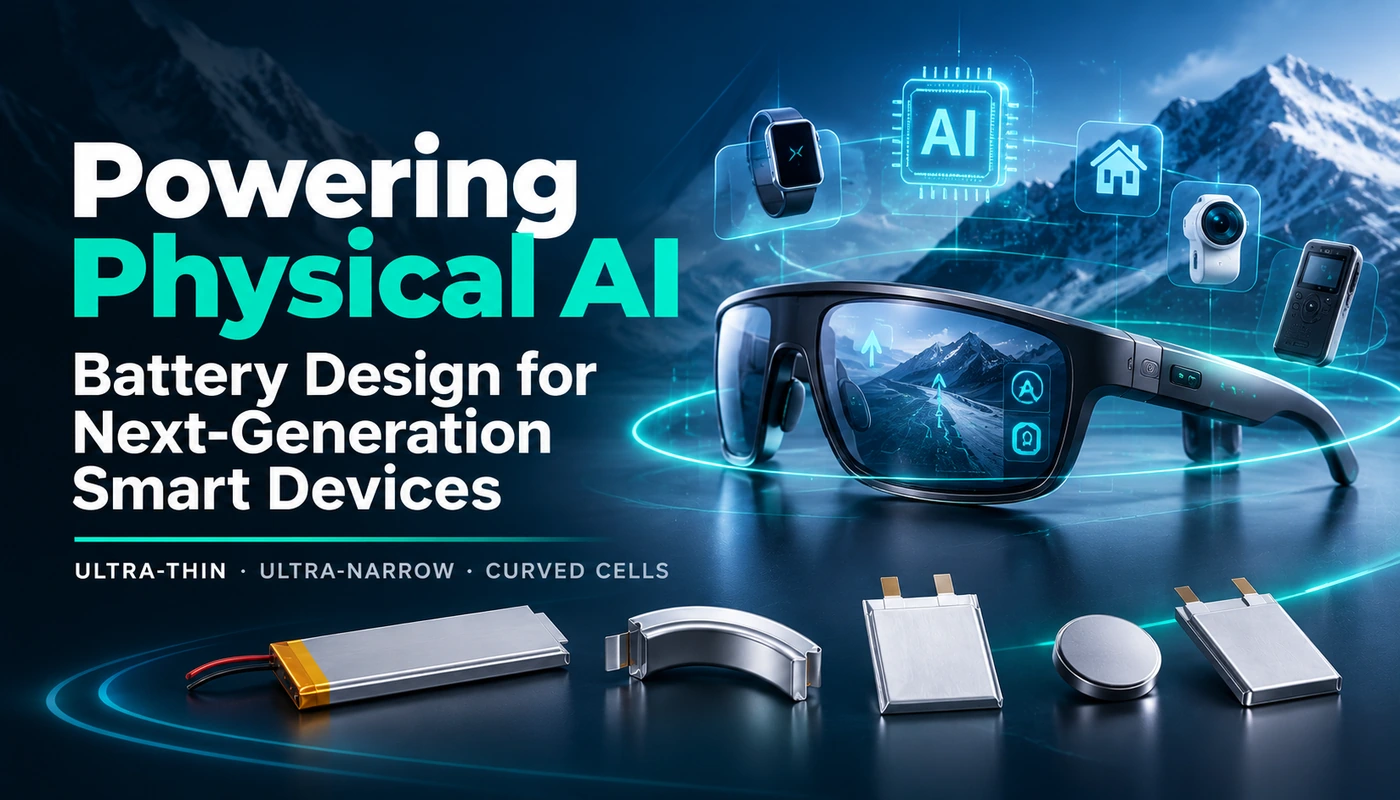
For eyewear manufacturers, the battery must fit inside narrow temples without making one side noticeably heavier. Grepow develops ultra-narrow and custom-shaped batteries for smart glasses, including solutions for cycling glasses, swimming goggles, and other space-constrained frames.
Simpler Wristbands May Find a Clearer Role
We encountered many wristbands with either a very small display or no display at all. Instead of competing directly with smartwatches, these products focused on continuous sensing, sleep monitoring, and lightweight daily wear.
Removing or reducing the display can lower part of the device's power demand, but it does not automatically solve the battery challenge. Sensor sampling, Bluetooth transmission, vibration alerts, and background processing still affect runtime. A slimmer band also leaves less room for the cell.
The opportunity is to make the device more comfortable and less distracting, then support that experience with a power system designed around the real operating cycle.
Smart Rings Are Splitting Into Health and Interaction Devices
Smart rings were widely represented at the show, but they were not all trying to solve the same problem. We saw a clear division between rings built for health monitoring and rings designed as compact input devices.
Health Rings Are Entering a More Mature Stage
Most health rings followed a familiar formula: sleep analysis, heart-rate monitoring, activity tracking, and app-based reports. We did not see a dramatic change in the core feature set.
That does not mean the category has stopped developing. It means differentiation is moving toward sensing reliability, algorithms, comfort, charging, and long-term wearability.
A systematic review covering 107 studies and roughly 100,000 participants found strong potential for smart rings in heart-rate, sleep, and remote-monitoring applications while also calling for more standardized validation and clinical research. (PubMed: Smart Rings in Clinical Medicine)
Battery geometry remains central because the cell competes with sensors, antennas, the PCB, and the inner ring diameter. Grepow's curved smart-ring batteries are designed to use the ring's arc more efficiently than a small rectangular cell.
Control Rings Are Emerging as a Separate Product Category
Control rings took a different approach. The products we saw were used for page turning, photography, short-video control, cursor movement, and gesture-based interaction.
These devices generally have lower power requirements than continuously monitoring health rings. Some can use conventional miniature pouch cells, which may be more economical than developing a curved battery. Their larger opportunity could be as companion controllers for smart glasses and other screen-free devices.
This is not only an exhibition concept. Microsoft Research previously demonstrated LightRing, a ring-form sensor capable of tracking fingertip movement and supporting two-dimensional input on ordinary surfaces. (Microsoft Research: LightRing)

Electronics Are Becoming Jewelry and Fashion Accessories
Wearable electronics have traditionally looked like electronic products. The next wave may need to look like something people would wear even without the electronics inside.
McKinsey's wellness research found that younger consumers increasingly treat wellness as a personalized daily practice spanning health, sleep, fitness, appearance, and mindfulness. That overlap creates room for products combining sensing or recording functions with personal style. (McKinsey & Company: The $2 Trillion Global Wellness Market)
Smart Earrings Turn Sensors Into Jewelry
One early-stage smart earring prototype we examined combined a replaceable decorative piece with a health-monitoring module. Its stated specifications included an 18mAh rectangular pouch cell and a total weight of approximately 12 grams.
The concept still appeared to be at an early commercial stage, but the wearing position has research value. A University of Washington prototype used the earlobe for continuous temperature sensing and achieved 28 days of operation through a 14.4-microwatt design. (University of Washington: Low-Power Smart Earring Research)
For this category, adding capacity is not always the best answer. Reducing consumption, weight, and thickness may matter more. Battery placement also affects balance and whether the earring remains comfortable after several hours.
Recording Pendants Combine Function With Personal Style
We also saw an AI recording pendant designed to look like jewelry. The sample used a round battery rated at approximately 180mAh, while its companion app added recording, transcription, and styling suggestions.
Round, curved, and ultra-thin batteries can help designers preserve a pendant-like appearance instead of building a rectangular recorder with a necklace attached. Our battery solutions for compact voice recorders cover several of these space-constrained formats.
Smart Badges Have Room to Become More Capable
Current smart badges often focus on displaying photos, animations, or personal information. Future versions could add microphones, voice interaction, sensors, or local processing.
That evolution would significantly change the power profile. MIT Media Lab research has demonstrated wearable badges combining microphones, speakers, accelerometers, infrared sensing, radio communication, and Bluetooth connectivity. (MIT Media Lab: Wearable Communicator Badge)
As badges gain functions, manufacturers may need to reconsider cell shape, peak-current capability, thermal behavior, and charging frequency, not simply install a larger battery.
Product Integration Is Creating New Battery Architectures
Another notable direction was the integration of multiple products into one wearable system. This can simplify what users carry, but it makes power distribution and charging more complicated.
Research on wearable energy systems notes that most manufacturers still rely on established lithium-ion and lithium-polymer cells because they offer mature performance, supply chains, and power-management infrastructure. It also highlights the tradeoff between mechanical flexibility and electrical performance in emerging wearable power sources. (National Library of Medicine: Wearable Energy Systems)
A Watch Can Also Become an Earbud Case
We saw products that stored and charged wireless earbuds inside a smartwatch. This turns the watch into both a wearable device and a charging case.
The design must support the watch's daily operation while reserving energy for the earbuds. Cell placement also affects watch thickness, wrist comfort, internal heat, and mechanical strength. Grepow's custom smartwatch battery solutions include round and shaped formats for different internal layouts.
Smart Glasses and Control Rings Can Work as a System
Smart glasses need a convenient input method, particularly when they do not have a large display or when voice control is inappropriate. A control ring can provide discreet commands without requiring the user to touch the frame.
In this type of ecosystem, the two devices should not be optimized separately. Communication frequency, standby strategy, charging accessories, and expected daily use should be modeled as one system. A small improvement in wireless or standby efficiency may provide more value than adding battery capacity to both products.
Not Every New Product Needs a Custom-Shaped Battery
As a custom battery manufacturer, we see clear value in shaped cells, but we also believe customization should solve a real design problem.

Smart Clothing May Be Better Served by a Detachable Pack
The heated and cooling garments we saw mainly used external power banks. That approach may add some bulk, but it simplifies charging, replacement, washing, and maintenance.
Smart textiles still face a fundamental challenge in finding power supplies that are safe, lightweight, and compatible with movement. (Nature Reviews Materials: Energy-Harvesting Clothes)
A customized embedded cell makes sense when thinness, balance, or concealment is essential. For products that prioritize serviceability, a removable module may be the better architecture. Grepow can support both approaches through custom batteries for smart clothing.
Sleep Audio Devices Need Comfort Before Novelty
One under-pillow sleep speaker we examined used a detachable rectangular battery rated at approximately 200mAh. An ultra-thin cell could make the product slimmer, but the existing rectangular battery may already meet its runtime and comfort requirements.
This is a useful reminder: a novel battery shape is not automatically a better solution. If a standard cell fits safely, meets the target runtime, and keeps the product commercially viable, unnecessary customization can add cost and development time without improving the user experience.
What Brands Should Decide Before Customizing a Battery
We recommend starting battery discussions before the enclosure and PCB layout are frozen. The battery supplier needs more than a target voltage and capacity to evaluate whether an existing cell, modified platform, or fully customized design is appropriate.
| Information to Prepare | Why It Matters |
|---|---|
| Available battery space | Defines thickness limits, curves, restricted areas, and possible cell geometries |
| Average, standby, and peak current | Helps determine usable capacity, discharge capability, and voltage stability |
| Target runtime and charging time | Establishes the required energy and acceptable charging strategy |
| Weight and balance requirements | Prevents the battery from reducing comfort or creating an unbalanced wearable |
| Operating and charging temperatures | Influences cell chemistry, protection settings, and performance validation |
| Wearing position | Affects thickness, thermal comfort, impact risk, and proximity to the body |
| Electrical and protection requirements | Identifies the need for wires, connectors, PCM, NTC, or battery-management functions |
| Target markets and annual volume | Helps define certification requirements, development cost, and production planning |
Academic reviews of flexible wearable power sources emphasize that electrical performance, mechanical flexibility, durability, and safety must be considered together rather than optimized separately. (Science Advances: Flexible and Stretchable Power Sources for Wearable Electronics)
Once these requirements are understood, we can compare three paths: an existing standard cell, a modified standard platform, or a fully customized shape. Our custom-shaped battery capabilities include curved, round, ultra-thin, ultra-narrow, and irregular pouch-cell designs.
Conclusion
The products we saw in Hong Kong suggest that the next stage of consumer electronics will be defined less by entirely new categories and more by better specialization.
Smart glasses are moving into sports. Bands are becoming less intrusive. Rings are separating into sensing and control products. Earrings, pendants, and badges are turning electronics into personal accessories. Watches, earbuds, glasses, and controllers are beginning to operate as connected systems.
For brands, the product opportunity lies in choosing a clear use case and engineering every component around it. For us at Grepow, the role of battery customization is to support that product logic, not to complicate it.
FAQ
Consumer Questions
Why would I wear a smart earring or pendant instead of a smartwatch?
Earrings and pendants can offer different sensing positions, recording functions, and styling options. Their value depends on whether they provide a more comfortable or natural experience than a wrist-worn device.
Does a smaller wearable always have shorter battery life?
Not necessarily. Runtime depends on sensor activity, wireless communication, processing, display use, and standby efficiency. A well-optimized low-power product can operate longer than a larger device with heavier workloads.
Questions From Product Teams
When should we choose a custom-shaped LiPo cell instead of redesigning the enclosure around a standard battery?
Customization is most valuable when a standard cell causes excessive thickness, poor balance, wasted internal space, or reduced wearing comfort. If a standard cell already meets the mechanical, electrical, safety, and cost targets, it may remain the better choice.
What information should we provide Grepow during the concept stage of a wearable project?
Provide the available space, CAD drawings, target capacity, average and peak current, runtime, charging requirements, operating temperature, weight limit, protection needs, certification markets, and expected production volume.
How should we balance runtime, weight, comfort, and charging in a multi-device wearable system?
Model the complete user routine rather than maximizing each battery independently. Define which device stores energy, how often each component communicates, where charging occurs, and how much weight the user will tolerate at each wearing position.