




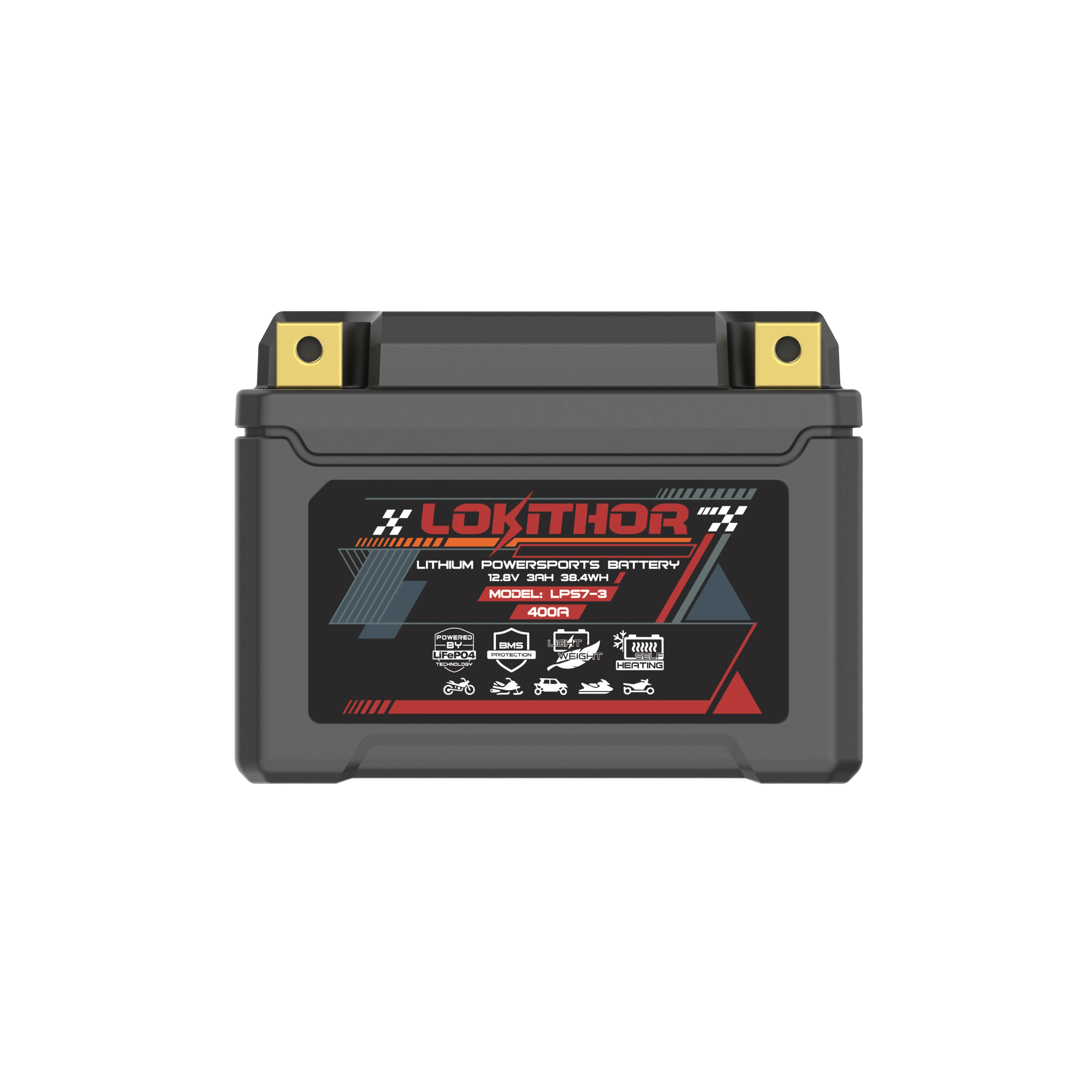









A request for a 24V 60Ah LiFePO4 starting battery may appear to provide a complete battery specification. In practice, it defines only the approximate system voltage and energy capacity. It does not tell a battery manufacturer how much current the starter requires, how long the current pulse lasts, how far the voltage may drop during cranking, or whether the vehicle must start after extended exposure to low temperatures.
These missing details are especially important for off-road trucks, diesel-powered equipment, construction machinery, generator sets, and other 24V systems. Starting an engine creates a short but demanding electrical load that is very different from operating a steady DC load.
For this reason, a 24V 60Ah battery should be treated as a possible design direction rather than a confirmed starting solution. The battery must be evaluated against the actual starter, charging system, operating environment, installation space, and required starting sequence.
This guide explains the information OEMs and system integrators should review before developing a 24V high-discharge LiFePO4 starting battery.

What Do 24V and 60Ah Tell Us?
The voltage and amp-hour rating provide two useful pieces of information, but neither directly defines starting performance.
A 24V-Class Electrical Platform
A 24V LiFePO4 battery commonly uses eight cells connected in series, producing a nominal battery voltage of approximately 25.6V. However, nominal voltage alone does not confirm compatibility with a vehicle.
Engineers must also check:
Maximum charging voltage
Alternator output and charging profile
Low-voltage protection behavior
Voltage limits of connected controllers and electronic equipment
Existing battery monitoring or supervision systems
A battery may have the correct nominal voltage but still be incompatible with the vehicle's charging system or protection logic.
A 60Ah Capacity
The 60Ah rating describes how much charge the battery can store under defined test conditions. It helps determine available energy, auxiliary-load runtime, standby duration, and the energy reserve for repeated starting attempts.
It does not independently determine:
Peak starting current
Continuous discharge current
Cold-cranking capability
Voltage drop during cranking
BMS overcurrent behavior
The number of successful starts at low temperature
Two 60Ah batteries can have very different starting performance because they may use different cells, internal connections, BMS designs, terminals, cables, and thermal structures.
Capacity therefore answers the question "how much energy is stored," while starting performance answers the question "how quickly and reliably can the required power be delivered?"
What Determines Starting Performance?
Engine starting is a system-level event. The battery, starter motor, cables, terminals, BMS, temperature, and state of charge all influence the result.
Peak Current and Pulse Duration
A starter motor can draw a high current immediately after it is energized. The battery must support this load without excessive voltage drop or an unexpected BMS shutdown.
A peak-current value is meaningful only when it is accompanied by a time condition. A current supported for a fraction of a second cannot automatically be treated as a current available for several seconds.
A useful specification should therefore define:
Peak current
Pulse duration
Initial battery state of charge
Cell and ambient temperature
Minimum permitted terminal voltage
Recovery time between pulses
Number of repeated starting attempts
Without these conditions, a peak-current figure cannot reliably predict engine-starting performance.
Continuous Discharge Current
Continuous discharge current describes the current a battery can support for an extended period under specified conditions. It remains important for auxiliary loads, pumps, inverters, control systems, or other equipment operating after the engine starts.
However, continuous current and cranking current are not interchangeable. Both must be reviewed when the battery supports engine starting and other vehicle loads.
Voltage Drop During Cranking
A battery can retain sufficient capacity while still failing to start an engine if its voltage drops too far under load.
Voltage drop is affected by the combined resistance of:
Battery cells
Cell tabs and interconnections
Busbars
BMS switching components
Contactors or fuses
Internal and external cables
Connectors and terminals
At high current, even a small increase in resistance can create a significant voltage loss. The resulting voltage may be too low for the starter, electronic control unit, relays, or fuel system to operate correctly.
For a starting-battery project, the minimum voltage measured during cranking is therefore one of the most important validation results.
BMS Current Limits
The battery management system must protect the battery without interrupting a normal starting event.
If the BMS overcurrent threshold is too low, or if its protection delay is too short, the battery may shut down even though the cells could support the required pulse. If the threshold is too high, the battery may not be adequately protected during a fault.
The BMS specification should be developed around the actual load profile rather than selected from the battery capacity alone.
Temperature and State of Charge
Low temperature can increase internal resistance and reduce the battery's ability to maintain voltage under a heavy load. A battery that starts an engine successfully at room temperature may behave differently after a long low-temperature soak.
Testing should reproduce the intended operating conditions, including:
Minimum ambient temperature
Battery soak time
Initial state of charge
Starter load
Cranking duration
Number of repeated attempts
Time allowed between attempts
Low-temperature charging must also be evaluated separately from low-temperature discharge. The charging strategy may require temperature monitoring, current limits, heating, or other protection measures.
Grepow's Existing High-Discharge LiFePO4 Technology
Grepow already publishes high-discharge LiFePO4 cell and battery data that can serve as technical references for evaluating a future 24V starting-battery project.
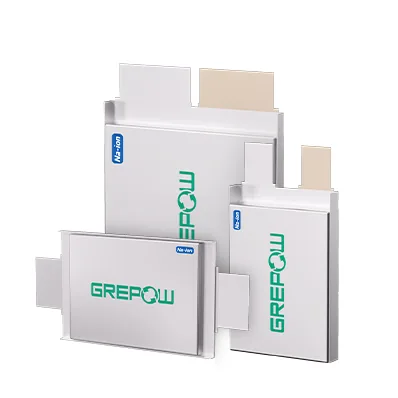
High-Discharge LiFePO4 Pouch Cells
Grepow's published 40C high-discharge LiFePO4 cell range includes 3.2V pouch cells with capacities from 1.7Ah to 7.8Ah. The listed maximum continuous discharge currents range from 68A to 312A, depending on the model.
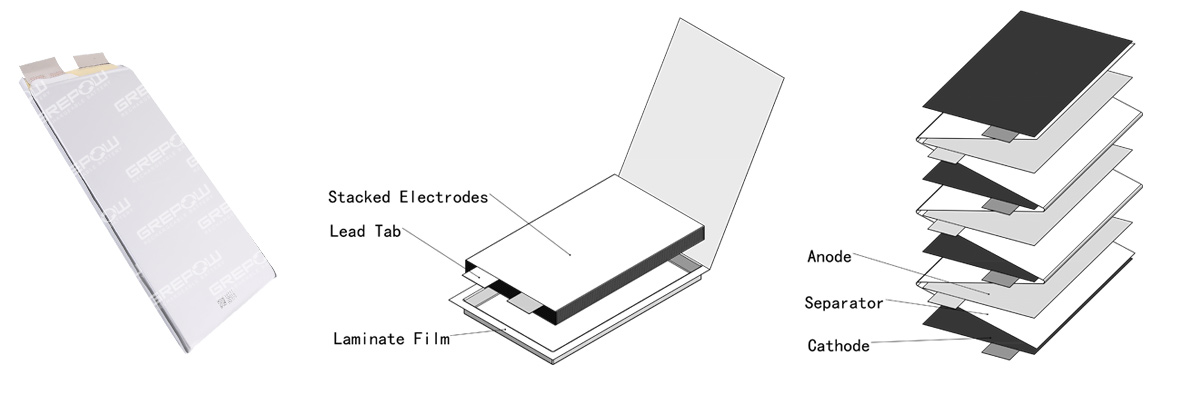
Grepow uses a stacked pouch-cell structure for its high-discharge LiFePO4 cell platforms.
The same page presents test curves for a 1.6Ah test cell. It reports more than 93% discharge efficiency from 30C to 40C and more than 94% capacity retention after 300 cycles under a test using 1C charging and 25C discharging.
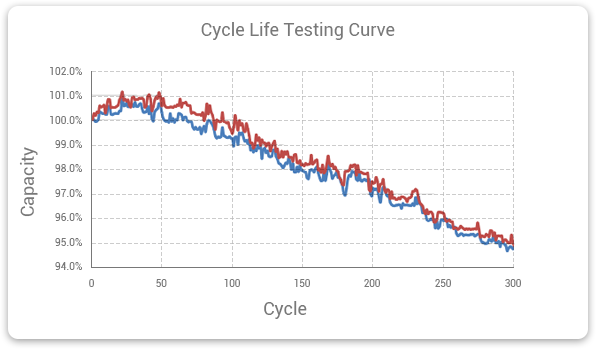
The published curve reports more than 94% capacity retention after 300 cycles under 1C charging and 25C discharging. The result applies to the stated test cell and conditions, not to a future 24V 60Ah battery design.
These results demonstrate Grepow's existing work with high-discharge LiFePO4 cell technology. They should not, however, be interpreted as the specification of a future 24V 60Ah battery. Pack-level performance depends on the selected cell, series-parallel configuration, BMS, interconnections, thermal design, and mechanical structure.
Existing 24V High-Current Battery Platform
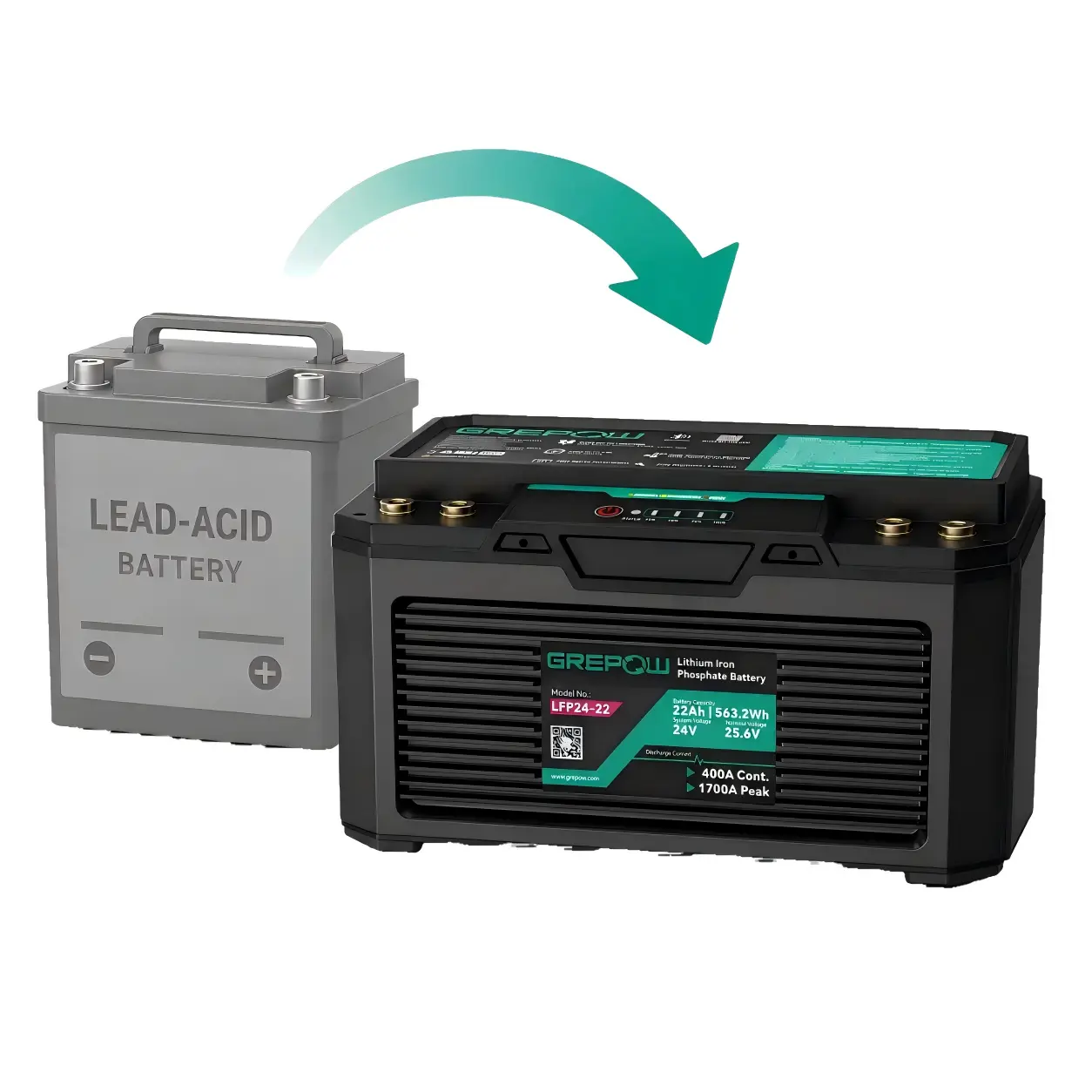
Grepow also offers the LFP24-22 high-discharge LiFePO4 battery, an existing 25.6V 22Ah platform rated at 400A continuous discharge and up to 1700A peak discharge.

The existing LFP24-22 is a 25.6V 22Ah high-discharge reference platform. It is not a 60Ah off-road truck starting battery.
This battery includes an integrated BMS, Bluetooth monitoring, and protection against overcharge, over-discharge, overcurrent, short circuit, cell imbalance, and abnormal temperature. It is positioned for high-power backup and surge-load applications.
The LFP24-22 provides a useful reference for Grepow's pack-level high-current capabilities, but it is not a 60Ah off-road truck battery and should not be treated as proof of compatibility with a specific engine or vehicle.
A 60Ah starting-battery project would require its own electrical, thermal, mechanical, and equipment-level validation.
Could a 60Ah-Class Battery Meet the Starting Requirement?
Possibly, but capacity alone cannot answer the question.
A 60Ah configuration may provide useful energy reserve for auxiliary loads, repeated starts, or extended standby periods. Its ability to start an engine will still depend on the selected cell and complete battery design.
Before determining whether 60Ah is appropriate, the following questions should be answered:
What is the actual starter current during the first milliseconds of cranking?
How long does the normal starting sequence last?
What is the maximum acceptable voltage drop?
What is the minimum operating temperature?
How many consecutive starting attempts are required?
What auxiliary loads operate before, during, or after starting?
What charging voltage and alternator behavior does the vehicle use?
What battery dimensions and terminal arrangement are available?
What vibration, shock, water, dust, and environmental requirements apply?
What certifications or system-level approvals are required?
If measured current data are unavailable, the existing battery datasheet, starter motor model, starter power, engine information, cable configuration, and observed starting behavior can support a preliminary evaluation. Measurement on the target equipment should still be included before the design is finalized.
Special Requirements for Off-Road Trucks
Cold Starting
A vehicle may remain outdoors for many hours before the engine is started. The relevant test is not simply whether the battery can discharge at a stated temperature, but whether it can deliver the required current after an appropriate low-temperature soak while maintaining sufficient terminal voltage.
Repeated Starting
Some operating cycles require frequent engine starts. Failed starts may also require several consecutive attempts. The battery must provide the necessary pulse repeatedly without excessive voltage sag, temperature rise, or protection activation.
Vibration and Mechanical Shock
Road conditions, engine vibration, and vehicle movement affect the battery enclosure, internal connections, terminals, and mounting structure. Cell performance alone does not establish mechanical suitability for an off-road application.
Dust, Water, and Contamination
The required enclosure design depends on the installation location and environmental exposure. Connector sealing, venting, corrosion protection, and ingress protection requirements should be defined before structural design begins.
Vehicle Charging Compatibility
A battery installed in a vehicle interacts continuously with the alternator, voltage regulator, and electrical loads. The charging voltage range, voltage transients, idle charging behavior, and expected charging current should be reviewed.
A battery should not be described as a direct lead-acid replacement simply because its nominal voltage and capacity are similar to those of the existing battery.
For a broader explanation of this system-level evaluation, see Grepow's guide to high-discharge LiFePO4 lead-acid replacement batteries for 12V and 24V systems.
Information Required for a Project Evaluation
Providing the right information at the beginning of a project helps determine whether a 60Ah design is technically and commercially appropriate.
| Requirement | Information to Provide |
|---|---|
| Application | Vehicle, engine, generator, construction machine, agricultural equipment, or other system |
| Existing Battery | Brand, model, voltage, capacity, CCA or current rating, and datasheet |
| Starting Load | Peak current, current waveform, pulse duration, minimum voltage, or starter motor information |
| Temperature | Minimum and maximum operating temperatures, including required cold-soak conditions |
| Starting Sequence | Typical cranking time, starts per day, consecutive attempts, and recovery interval |
| Auxiliary Loads | Electronics, pumps, lighting, communications, or other loads powered by the battery |
| Charging System | Alternator voltage range, charging current, charging profile, and abnormal-voltage conditions |
| Mechanical Requirements | Available space, maximum weight, terminal position, mounting method, and cable size |
| Environmental Requirements | Vibration, shock, dust, water, humidity, salt, or chemical exposure |
| Project Information | Sample quantity, forecast annual volume, target price range, and project schedule |
Customers do not need to have every value before making an inquiry. Available data can support a preliminary review, after which missing measurements and validation requirements can be identified.
From Market Requirement to Battery Sample
A custom starting-battery project should progress through defined technical and commercial stages.
1. Inquiry
The customer provides the application, existing battery information, expected capacity, operating conditions, estimated order volume, and target schedule.
2. Requirement Evaluation
Grepow reviews whether the requested voltage and capacity direction is consistent with the load, environment, installation constraints, and commercial requirements.
At this stage, 60Ah may be retained as the target capacity, adjusted, or compared with other configurations.
3. Specification Definition
The customer and battery engineering team define the required:
Nominal voltage and capacity
Continuous and peak current
Peak-current duration
Minimum voltage under load
Temperature range
BMS functions and communication
Dimensions and terminals
Enclosure and environmental protection
Validation conditions
4. Feasibility Review and Quotation
Once the main requirements are sufficiently clear, the project can be reviewed for cell selection, electrical architecture, BMS design, mechanical structure, development cost, sample plan, estimated pricing, and production feasibility.
5. Sample Development
Samples should be produced after the key performance targets and interfaces have been agreed. This avoids building a nominal 24V 60Ah battery that cannot be meaningfully evaluated against the target equipment.
6. Equipment-Level Validation
Final validation should use the intended vehicle or an equivalent load profile. Testing should record current, voltage, temperature, starting time, protection status, and repeated-start behavior under relevant environmental conditions.
Passing a cell-level or bench-level discharge test does not automatically establish compatibility with a particular vehicle.
Request a 24V Starting Battery Evaluation
Grepow is evaluating custom 24V high-discharge LiFePO4 starting-battery requirements for off-road trucks, diesel-powered equipment, generator sets, and other 24V systems.
If your project is considering a 60Ah-class battery, send us:
Your vehicle or equipment type
Existing battery model and datasheet
Starter motor or measured cranking information
Minimum operating temperature
Charging-system information
Available installation space
Terminal and connector requirements
Estimated sample quantity
Forecast annual volume
Target project schedule
Grepow can use this information to review the application, identify missing parameters, discuss a preliminary battery specification, and evaluate the commercial and technical feasibility of developing samples.
Submit your 24V starting-battery requirements to begin a project evaluation and quotation.
FAQ
Does a 60Ah rating determine the battery's cranking current?
No. Capacity and cranking capability describe different aspects of battery performance. Cranking current depends on the cell design, internal resistance, BMS, connections, temperature, state of charge, and permitted pulse duration.
Is a 24V LiFePO4 battery normally rated at 25.6V?
A common 24V-class LiFePO4 configuration uses eight 3.2V nominal cells in series, resulting in a 25.6V nominal voltage. The complete operating and charging voltage range must still be checked against the target system.
Can a 24V 60Ah LiFePO4 battery directly replace a 24V 60Ah lead-acid battery?
Not automatically. Engineers must compare charging requirements, continuous and peak currents, voltage drop, low-temperature performance, BMS behavior, dimensions, terminals, mounting, and equipment-level protection logic.
Is C-rate enough to select a starting battery?
No. C-rate should be accompanied by the actual current, pulse duration, temperature, state of charge, cutoff voltage, and repeatability conditions. Pack-level limitations must also be considered.
What if the starting-current waveform is unavailable?
Provide the existing battery datasheet, engine information, starter motor model or power rating, cable specifications, minimum operating temperature, and observed starting behavior. These details can support an initial evaluation, followed by current and voltage measurement on the equipment.